Linear Algebra: Vector Addition & Scaling
Linear Algebra: Vector Addition and Scaling
Vector Addition Definition
Vector addition is simply adding two vectors together to generate a third vector. For example, if we say then .
Vector Addition Visually
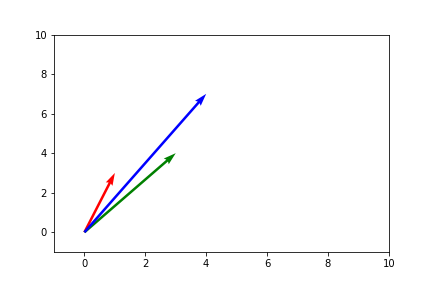
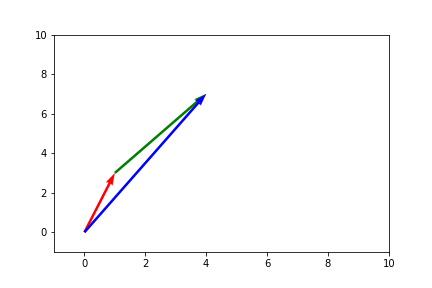
Vector addition can be visualed in 2-d space using the head-to-tail technique. Head-to-tail is simply putting the tail of the second vector on the head of the first vector. Let’s say we have . We know that the resulting vector is .
Vector Scaling
Vector scaling is multiplying a vector by a constant to get a vector scaled with . Scaling can be done for a vector of any number of dimensions. If we have and constant , then .
Vector Scaling Visually
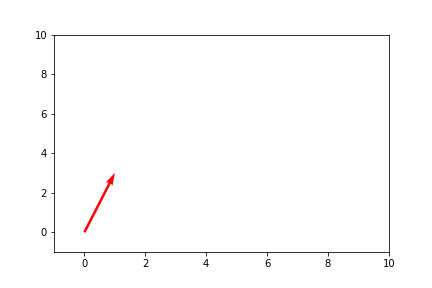
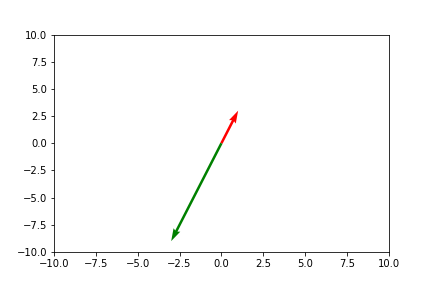
Visually, vector scaling will result in a larger or smaller vector pointing in the same direction if multiplied by a positive , or a larger or smaller vector pointing in the opposite direction if multiplied by a negative .